
 English
 简体中文
简体中文 Русский
 Français
 Português
 Español

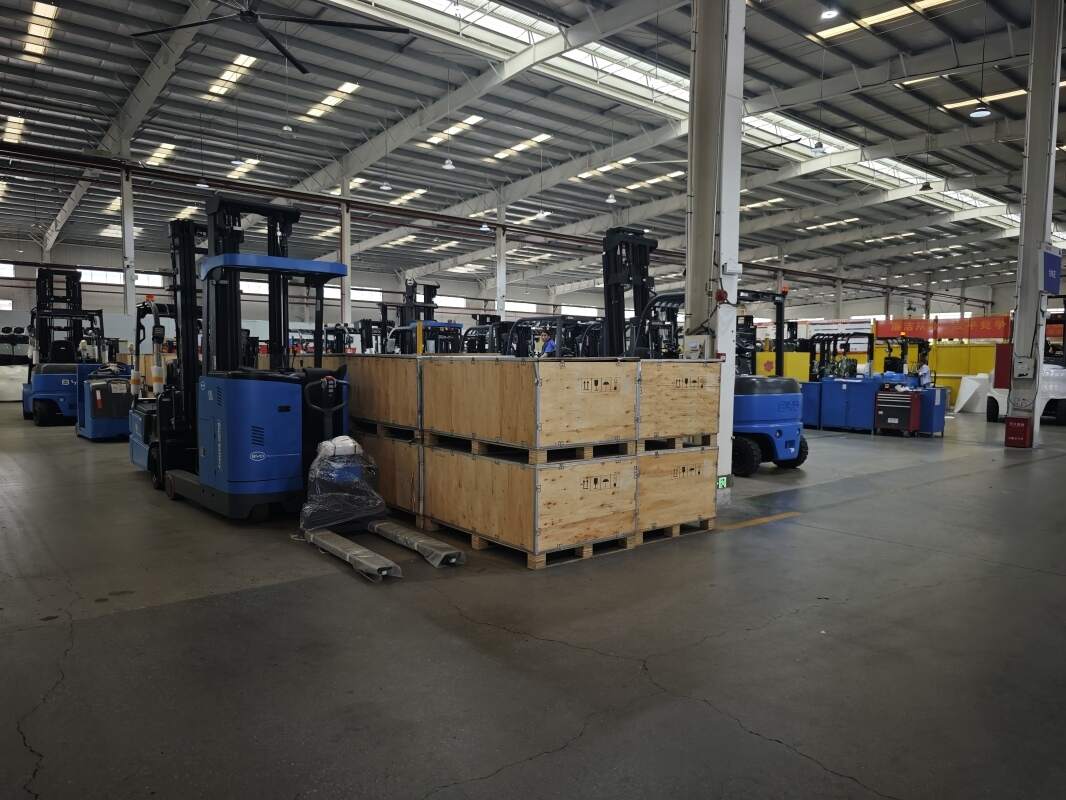
In modern logistics warehousing scenarios, dock and enclosed trailer handling operations occupy a core position in the whole material flow process, and the matching of handling equipment directly affects the overall operation efficiency and operation safety. As electric forklifts feature zero local emissions, low operating noise and low daily maintenance cost, they have become the first choice for most indoor and semi-outdoor loading and unloading scenarios, while many operation teams face difficulties in choosing between standard electric forklift and compact three-wheel model when making equipment procurement plans.
The standard electric forklift adopts a mature counterweight layout, and its balance system is calibrated for medium and long distance movement and heavy load carrying conditions. With a wider wheelbase and reasonable weight distribution on both sides of the car body, it can maintain stable driving state even when carrying rated full load on the sloped section between the storage yard and the dock, and avoid accidental shift of goods during high-speed transfer. For scenarios that require a large number of whole-pallet transfer operations on the open area outside the dock, this type of forklift can give full play to its balance advantage, and there is no need for frequent deceleration adjustment in the process of shuttling between the storage area and the dock berth. But its larger body size and larger turning radius make it difficult to turn flexibly in the narrow internal space of the trailer, and extra space is needed to adjust the direction to complete the stacking operation.
The compact three-wheel electric forklift adopts a special centripetal balance design, the overall center of gravity of the whole vehicle is lower, and the rotating pivot of the steering wheel is located in the center of the body, which can realize almost zero turning radius. Its balance system is optimized for low-speed fine operation in narrow space, even in the narrow trailer interior with very limited left and right space and headroom, the operator can complete the position adjustment of the whole vehicle in one movement, and will not scratch the inner wall of the carriage or the stacked goods. Due to the light weight of the whole vehicle, its energy consumption is lower during daily operation, and the flexible balance performance can help operators finish loading and unloading work inside the trailer more efficiently. But under the condition of high-speed long-distance transfer, its stability performance is weaker than that of the standard model, and it is more suitable for short-distance fine operation scenarios.
There is no absolute distinction between good and bad for the balance performance of these two types of electric forklifts, and the most appropriate choice should be made according to the actual proportion of operation scenarios. If most of the daily work is the heavy load transfer outside the dock, the standard electric forklift can bring more stable operation experience, if most of the operation links need to go deep into the trailer for dense stacking, the compact three-wheel model can release higher operation efficiency. Many logistics teams choose to deploy these two types of equipment at the same time to cover different operation links, which can achieve a more balanced overall operation efficiency.


