
 简体中文
简体中文 Русский
 Français
 Português
 Español
 لالعربية

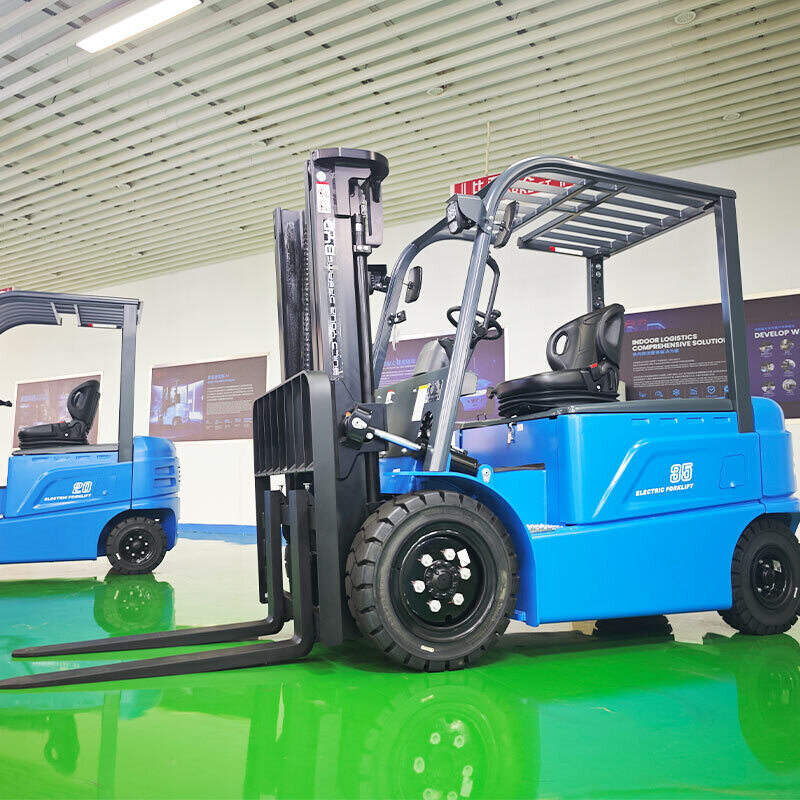
With the wide application of lithium-ion forklifts in modern material handling scenarios, charging configuration has become a core factor that affects daily operation efficiency and maintenance cost for most logistics teams. Different from traditional lead-acid forklifts that require long-time battery replacement and maintenance, lithium-ion forklifts support opportunity charging, so the matching of charger types will directly fit different daily workflow arrangements.
The external charger is an independent device separated from the forklift body, which is usually deployed at fixed centralized charging stations according to site layout. It does not occupy the limited installation space of the forklift body, so the power specification can be adjusted flexibly according to the overall fleet size. In daily workflow, this type of charger is more suitable for multi-shift high-frequency operation scenarios with a large number of forklifts in the same fixed work area. Multiple forklifts can take turns to use the external chargers at the centralized stations, and the maintenance team can complete daily inspection of charging line condition, interface stability and heat dissipation status at fixed points, which reduces the scattered management workload in the whole operation area. Its main limitation is that the forklift needs to return to the fixed charging station for supplementary power, if the temporary operation area is far away from the station, it will take extra empty driving time for power replenishment.
The integrated on-board charger is embedded around the electric control system of the forklift body in advance, and the whole set of modules is connected with the forklift power system synchronously. Operators can connect the forklift to any industrial power socket that matches the voltage specification for direct charging, no special fixed charging station is needed. In daily workflow, it is highly adapted to flexible operation scenarios with scattered work points, such as cross-zone material distribution across multiple workshops. Operators can make use of fragmented spare time, including short waiting period during cargo loading and unloading, shift handover break, to finish short-time supplementary power nearby, which effectively reduces extra empty driving mileage for returning to fixed stations. Restricted by the installation space and load limit of the forklift body, the power of the integrated on-board charger is usually lower than that of high-power external chargers, and the full charging cycle is relatively longer, and the unit procurement cost of the forklift with built-in charger module will increase correspondingly.
In actual daily operation, teams do not have to choose only one type of charger. Most scenarios can arrange collocation solutions according to different operation attributes of forklifts. Forklifts that work in fixed storage areas all day long can use centralized external charger groups, while transfer forklifts that need to travel across multiple areas can be equipped with integrated on-board chargers. This matching method can balance the overall investment of charging facilities and operation efficiency, to form a stable power replenishment system that fits the local workflow characteristics.


