English
 简体中文
 Русский
 Français
 Español
 لالعربية


Located on the western coast of Namibia, Walvis Bay is a core hub for regional port logistics, fishery processing, import and export warehousing and manufacturing distribution. Local daily material handling operations rely heavily on four-wheel forklifts, and an increasing number of enterprises are choosing electric forklift solutions in recent years for stable operation and lower long-term expenditure. For new users who switch to electric forklifts, rational control of power supply cost and standardized charging arrangement are two core factors that affect the actual operation benefit.
For Walvis Bay local operation scenarios, the power supply cost of electric four-wheel forklifts is closely related to local industrial and commercial electricity tariff rules. At present, the local industrial electricity price is divided into peak, flat and valley periods, and the electricity cost per kilowatt-hour is relatively stable throughout the year after excluding temporary policy adjustment. Compared with traditional internal combustion forklifts, the power consumption cost of electric four-wheel forklifts with the same load capacity and operation intensity is only 30% to 40% of the fuel cost of internal combustion equipment, and local enterprises can further reduce the cost by arranging charging during the low-price valley period at night according to their own shift schedule.
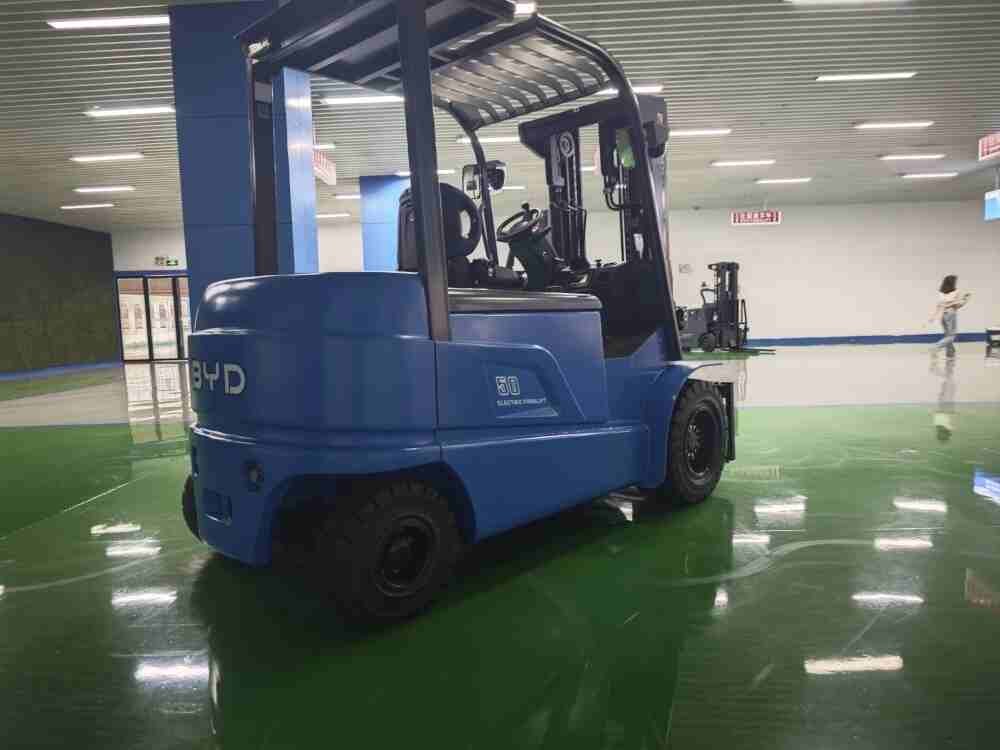
The charging arrangement of four-wheel electric forklifts in Walvis Bay needs to be adjusted according to actual operation intensity. For scenarios with single 8-hour work shift, the matched standard AC charging pile can fully charge the equipment after daily off work, which can meet the full day's operation demand without extra adjustment. For multi-shift high-intensity operation scenarios such as port container handling, supporting DC fast charging facilities can replenish enough power for 3 to 4 hours of operation within the 30-minute staff shift gap, which will not interrupt the normal operation process. It is also suggested that the charging area should be planned in a ventilated and rainproof zone, and regular anti-corrosion inspection of charging interfaces can adapt to the local coastal salt fog climate, to ensure the safety and stability of the charging process.
As Jian Shu New Energy, we focus on BYD electric forklift related supporting services, and can provide Walvis Bay local customers with practical services including power supply cost simulation calculation, charging site planning and operation specification guidance, to help enterprises formulate electric forklift use rules that fit their own operation rhythm. If you have relevant demand for consultation, you can send an email to [email protected] to contact us for targeted scheme suggestions.