English
 简体中文
 Русский
 Français
 Português
 لالعربية


In recent years, Zimbabwe’s warehousing, port transportation, agricultural product distribution and industrial manufacturing sectors have seen growing adoption of electric tow tractors for daily material handling operations, as more local operators prioritize stable operation cost control and low-emission site management. Many industry practitioners are now seeking clear, practical reference data on actual power supply cost and proper charging operation specifications, to arrange their fleet operation plans more reasonably.
For the power supply cost part, the actual operation data from local users shows that the overall power cost of electric tow tractors is closely linked to local grid tariff rules, operation scenarios and charging arrangement. Most local industrial areas have clear peak and valley power price gaps, charging fleets during low-demand valley periods at night can cut the unit power cost by a considerable margin compared with peak hour charging. For operation sites that cannot access stable grid connection, the matched off-grid photovoltaic power supply system can also provide long-term stable power support, and the accumulated operation cost for 5 consecutive years is far lower than the fuel cost of traditional internal combustion tow tractors of the same load level. The actual cost data varies according to the local operator’s specific daily operation mileage and on-site power conditions, operators can get targeted assessment data based on their own actual operation data.
For tow tractor charging arrangement, operators are suggested to make classified planning according to their own fleet size. For small fleets with less than 5 tow tractors, arranging dedicated slow charging piles in the closed parking area inside the warehouse can meet all daily operation demands, with no extra high investment for charging site transformation. For large fleets that run 2 shifts per day, setting up a small number of fast charging piles at the midway transfer station can effectively avoid operation interruption caused by power exhaustion. Operators also need to arrange regular inspection for charging piles and vehicle battery interfaces, to reduce unnecessary power loss in the charging process.
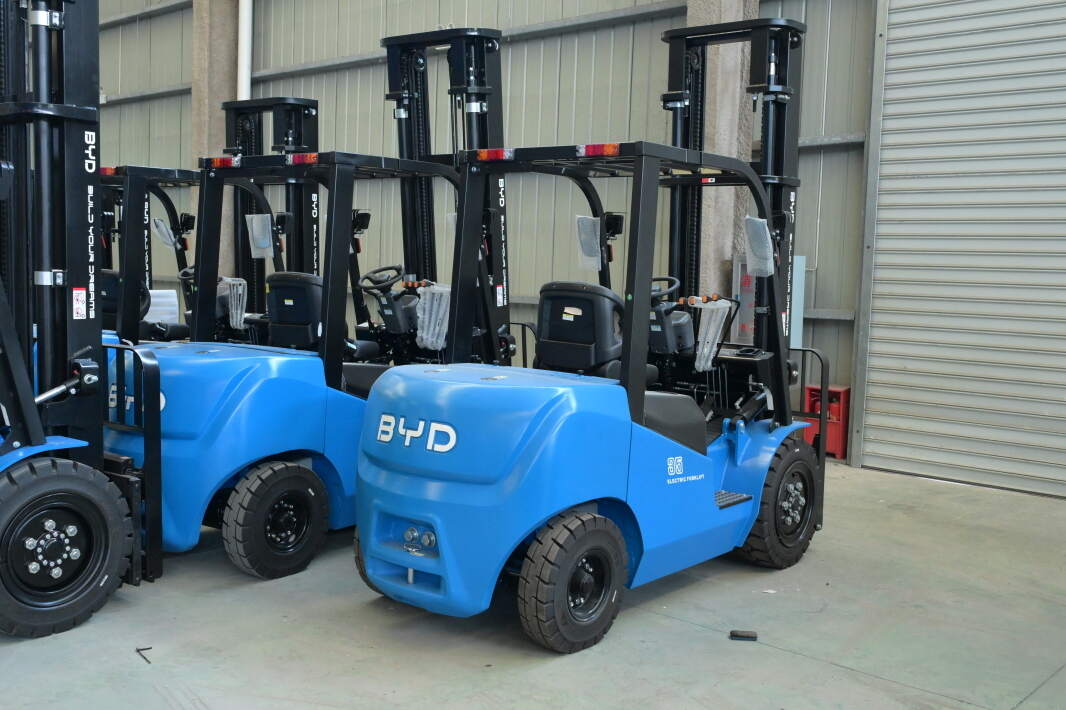
As Jianshu New Energy, we focus on BYD electric forklift related supporting services, we have accumulated rich experience in providing power supply cost assessment and charging layout planning services for Zimbabwe local material handling clients. All our schemes are fully adapted to local power supply conditions and industrial operation norms, helping clients control long-term operation cost in a reasonable range. If you need personalized power cost calculation report or charging scheme guidance, you can send email to [email protected] to get relevant professional support.