English
 Русский
 Français
 Português
 Español
 لالعربية


For warehousing, logistics, light manufacturing and port operation enterprises across Tunisia, the selection of material handling equipment directly impacts long-term operational revenue and operational efficiency. Three-wheel forklifts, known for their compact body size, flexible steering performance and strong adaptability to narrow aisle operation scenarios, have been widely applied in various local industrial scenarios in recent years, and the electric-driven type has gradually become the preferred choice for most enterprises.
Many local enterprises used to judge equipment value only by the initial purchase price in the past, while ignoring the total cost of ownership that runs through the whole lifecycle from equipment access to scrapping and recycling. A systematic decomposition of total cost of ownership of three-wheel forklifts can help local decision makers make more rational investment choices.
First, the initial purchase cost covers the equipment body cost, local certification registration cost, on-site debugging cost and operator basic training cost. Compared with fuel-powered counterparts, electric three-wheel forklifts may have slightly higher initial input, but the advantages in subsequent lifecycle operation links will gradually offset the gap.
The second part is the daily operation energy consumption cost. In Tunisia, the local industrial electricity tariff is far lower than the unit cost of fossil fuel when calculating the same operating hour, and the energy conversion efficiency of electric drive system is much higher than that of internal combustion drive system. For enterprises that use forklifts for 8 hours a day, the annual energy cost saving can reach a considerable level.
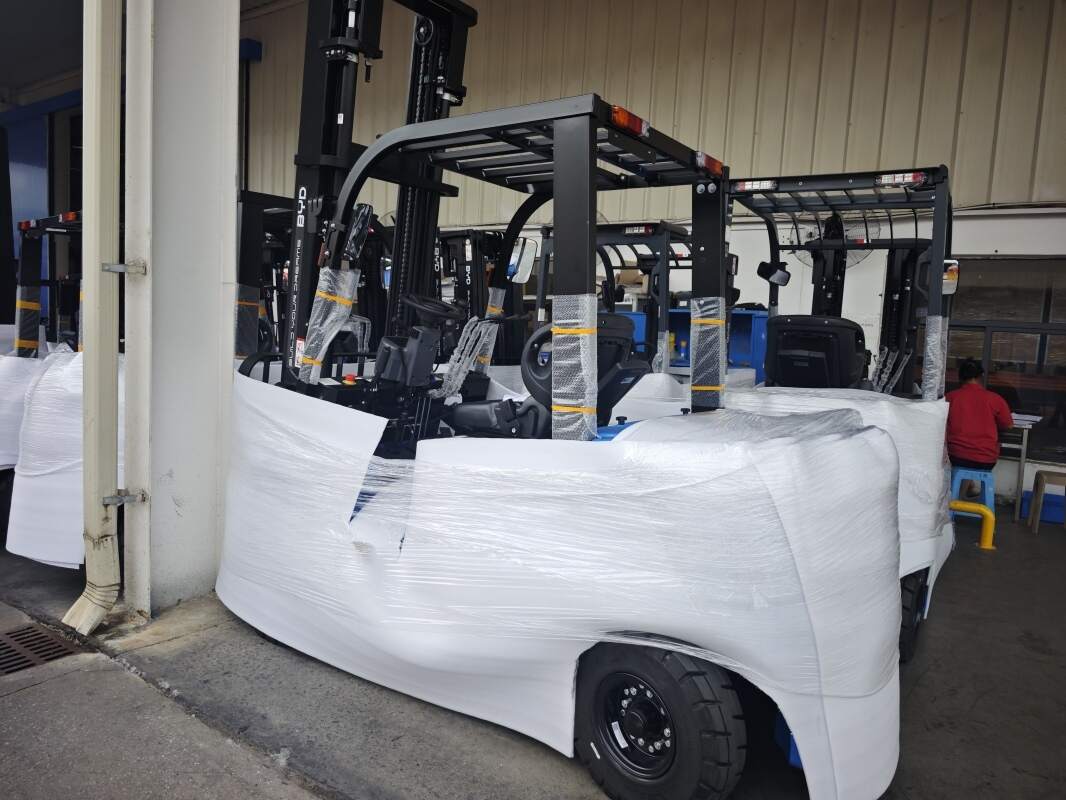
The third part is the routine maintenance and post-operation support cost. Electric three-wheel forklifts have no internal combustion engine structure that needs frequent replacement of oil, filter element and other consumable parts, the routine maintenance work is simpler, and the related consumable cost and labor cost of maintenance are significantly reduced. In addition, the zero-emission operation feature of electric forklifts can also help enterprises avoid extra environmental protection related management costs that may be incurred in subsequent operation.
As the equipment approaches the end of its lifecycle, the residual value part will also become an important component of the total cost of ownership. High quality electric forklifts with stable battery performance usually retain higher residual value after 8 to 10 years of normal use, which can further reduce the comprehensive cost in the whole lifecycle.
As Jianshu New Energy, we focus on BYD electric forklift products, and provide localized pre-sales consultation, cost calculation and after-sales support services for customers in Tunisia. If you have demand for personalized total cost of ownership analysis and three-wheel electric forklift solution consultation, you can send your demand to our email address: [email protected].