
 English
 简体中文
简体中文 Русский
 Français
 Português
 Español

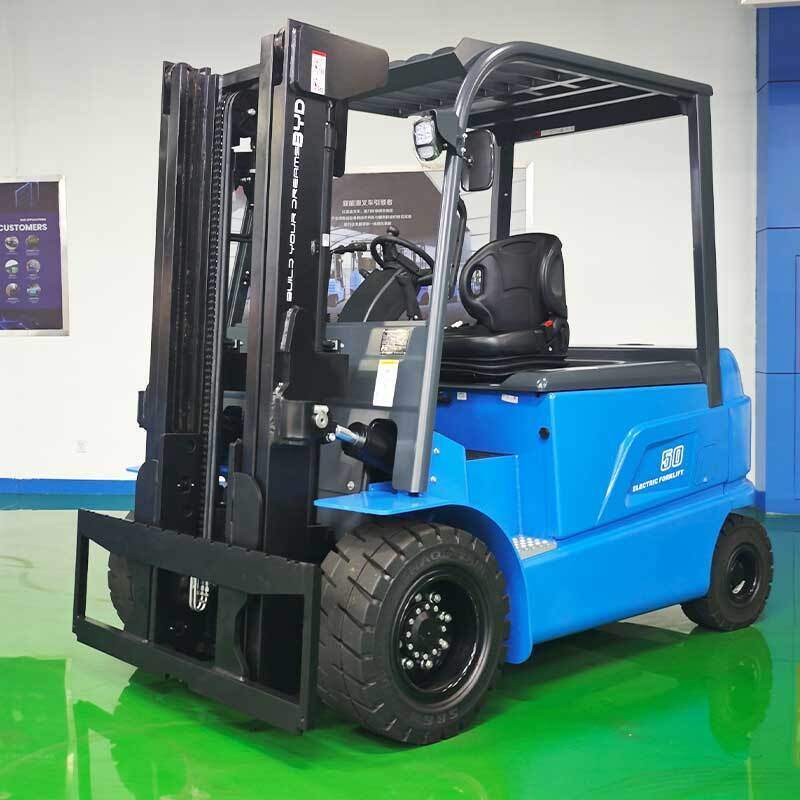
Counterbalance forklifts are widely applied as core material handling equipment across warehouses, manufacturing yards and distribution centers, where accurate load positioning is one of the most frequent and critical operations in daily workflows. Many operation planners often face the choice between counterbalance forklifts equipped with side-shift function and standard models without this extra structure, and a clear understanding of their difference in load positioning flexibility can help make more reasonable equipment configuration decisions that match actual operation demands.
For standard counterbalance forklifts without side-shift mechanism, the fork carriage is directly fixed to the mast assembly, which means any left or right adjustment of the load position requires the whole vehicle to move and reposition. Operators need to adjust the driving direction, back and forth multiple times to fine-tune the horizontal position of forks to align with pallet insertion holes, or put the load at the pre-set stacking position. This type of model performs stably in scenarios with sufficiently wide operation aisles, fully standardized pallet specifications and fully aligned fixed stacking positions. It has fewer moving parts related to the fork assembly, so the daily maintenance workload is relatively low, and it is suitable for scenes with highly standardized and fixed operation processes.
Counterbalance forklifts with side-shift function have an independent moving structure installed between the mast and the fork carriage, which supports the whole fork set to shift horizontally within a certain range without moving the entire vehicle. Operators can complete the fine adjustment of the load’s left and right position through a dedicated control lever on the handle, which greatly improves the flexibility of load positioning. When the insertion position of the pallet has a slight deviation, or there are small obstacles around the stacking position, the operator does not need to steer the whole vehicle to reposition, and can directly adjust the load position through the side-shift mechanism to avoid scraping surrounding goods, shelves or vehicle bodies. This feature is especially useful in narrow aisle scenarios, or scenes with mixed non-standard load specifications, which can effectively reduce the number of repeated vehicle movements in a single operation cycle and improve the overall operation efficiency.
There is no absolute superior or inferior between the two types of forklifts. Operation planners can evaluate the specific proportion of non-standard loads, average aisle width and daily operation flow characteristics of their own sites, to select the most matching model, so as to achieve a balance between operation flexibility and total input cost.


