English
 简体中文
 Русский
 Français
 Português
 Español


When you plan to upgrade your warehouse material handling fleet, the first critical decision you may face is picking the right model between counterbalance truck and reach truck. Many operation managers tend to skip targeted evaluation and pick a popular model blindly, which will lead to extra operation cost or insufficient operation efficiency later. The following core questions can help you clarify your actual demands and make a cost-effective choice.
First, you need to clarify your regular aisle width in daily operation scenarios. A standard counterbalance truck usually requires at least 3.5 to 4 meters of working aisle space to turn around and complete stacking operations, while a reach truck can work smoothly in aisles as narrow as 2.5 to 3 meters, since its mast extends forward to pick and place loads without the whole truck moving into the shelf working area. If your warehouse has narrow passages that are designed to expand storage capacity, you can prioritize evaluating the performance of reach trucks.
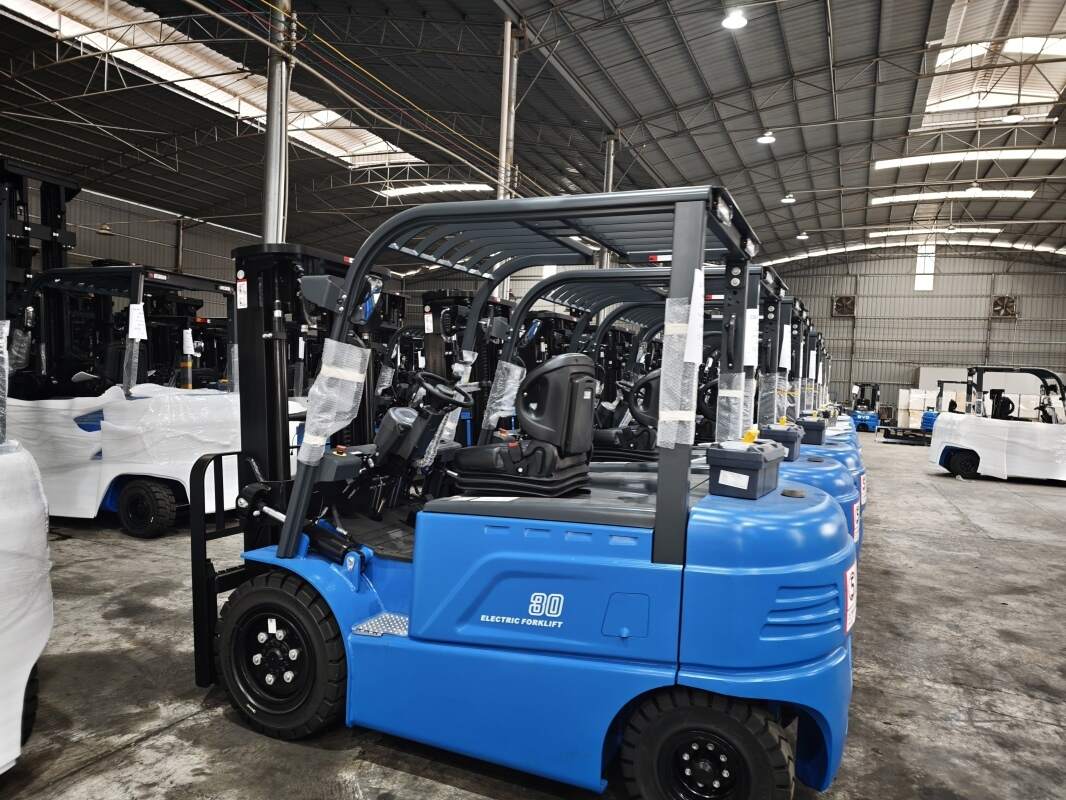
Second, confirm the maximum lifting height you need for daily stacking work. Most standard counterbalance trucks can support lifting height up to around 6 meters, which meets most low and medium height shelf operation demands. For scenarios that require stacking goods at height over 8 meters, the reach truck is a more appropriate choice, as its specialized mast structure is designed to support stable high-lifting operation without increasing the whole truck’s floor occupation.
Third, evaluate the common operation ground condition and load weight range. The counterbalance truck has a heavier counterweight at the rear, which provides better adaptive performance on uneven ground, loading docks and even short-distance outdoor transition scenarios, and can handle heavier loads of over 3 tons easily. The reach truck is more suitable for flat, smooth indoor warehouse floors, and it performs more stably when handling medium loads for long time high-position stacking work.
Fourth, calculate your expected daily operation hours and energy consumption cost. As both two types of new energy electric models use clean power sources, their total operation cost is far lower than traditional internal combustion models. Counterbalance trucks usually have larger battery capacity to support longer time of continuous shift operation, while reach trucks have lower whole machine power consumption to cut down daily charging energy cost.
At last, if you want to get customized professional suggestions for your specific operation scenario, you can turn to our professional team for further consultation. We are Jianshu New Energy, focusing on BYD electric forklift supply and full supporting services, you can contact us via [email protected] for more detailed professional support.