简体中文
 Русский
 Français
 Português
 Español
 لالعربية


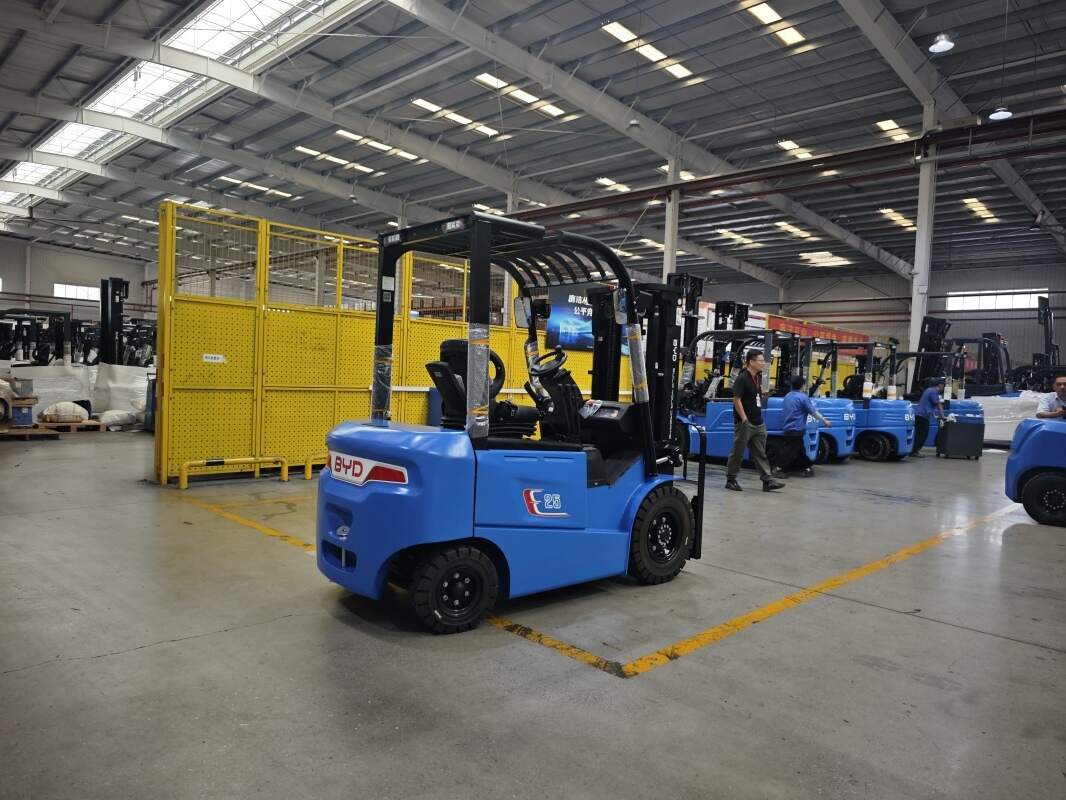
Against the backdrop of accelerating low-carbon transformation in the global logistics and material handling industry, electric forklifts have gradually become the mainstream choice for many operation scenarios including warehouses, manufacturing workshops and port freight yards. Many operation managers pay high attention to the battery configuration and use experience of electric forklifts in actual use, and the non-battery-swap design of BYD electric forklifts has received wide recognition from users in multiple industries for its practical performance in daily operation.
First of all, this type of forklift shows prominent advantages in operation continuity. The built-in power battery is designed with matched capacity according to the common operation intensity of most scenarios, which can support continuous full-load operation for a long time within one charge. Users do not need to arrange special staff to complete battery disassembly, replacement and reset operations midway, which avoids the operation pause caused by battery swap, and effectively improves the overall operation efficiency in peak freight periods.
Secondly, it effectively simplifies the daily operation and maintenance workflow. Users do not need to purchase extra spare battery packs in advance, nor do they need to occupy extra working area to build a special battery swap station, which reduces the extra capital investment in the early stage of project deployment. The regular daily inspection work only needs to cover the conventional status check of the battery, tyre and hydraulic system, which lowers the professional ability threshold for front-line maintenance personnel.
Thirdly, the integrated design of battery and whole vehicle brings better operation stability. Since there is no frequent plugging and unplugging of high-current interfaces during battery swap, the wear and potential poor contact risk of the circuit connection parts are reduced to a large extent. The power battery and the whole vehicle electric control system have completed deep adaptation and calibration before leaving the factory, which can maintain stable power output under different working conditions such as uphill carrying and frequent stacking operation.
In terms of full cycle use cost, the non-battery-swap design also shows outstanding economy. The charging interface of the forklift can be adapted to conventional industrial power supply facilities, and users do not need to carry out special power supply transformation for battery swap equipment. There is no extra cost generated in the link of battery swap equipment maintenance and spare battery daily management, which helps users control the comprehensive operation cost in the long run.
As a professional service provider focusing on BYD electric forklifts, Jianshu New Energy can provide users with full-scenario matching consultation and supporting service solutions. If you have any demand for related product consultation, you can send an email to [email protected] for further communication.