简体中文
 Русский
 Français
 Português
 Español
 لالعربية


The stability triangle is one of the most fundamental safety concepts that every forklift operator must master, as it directly determines the operational safety of material handling vehicles in daily warehouse and logistics scenarios.
To put it in plain terms, the stability triangle refers to the stable supporting area formed by connecting three fixed fulcrums of a standard counterbalance forklift. The first two fulcrums are the center points of the two front load wheels, and the third fulcrum is the center point of the rear steering axle. The three points are connected by imaginary lines to form a triangular invisible safety boundary for the vehicle.
The core working logic of the stability triangle is closely related to the center of gravity of the whole vehicle and the carried load. As long as the combined center of gravity of the forklift body, accessories and the handled cargo stays within the range of this triangular area, the vehicle will keep stable state and will not tip over. Once the combined center of gravity moves outside the edge of the stability triangle, the vehicle will lose its balance and face high risks of forward tipping or lateral tipping, which may cause property damage and even personal injury.
Multiple operation behaviors may push the combined center of gravity out of the stable triangle. For example, lifting the cargo to an overly high height, carrying load that exceeds the rated load capacity, taking sharp turns at high driving speed, operating on uneven or sloped ground, or carrying uncentered offset loads. All these improper operations will change the position of the combined gravity quickly, and break the stable balance of the forklift.
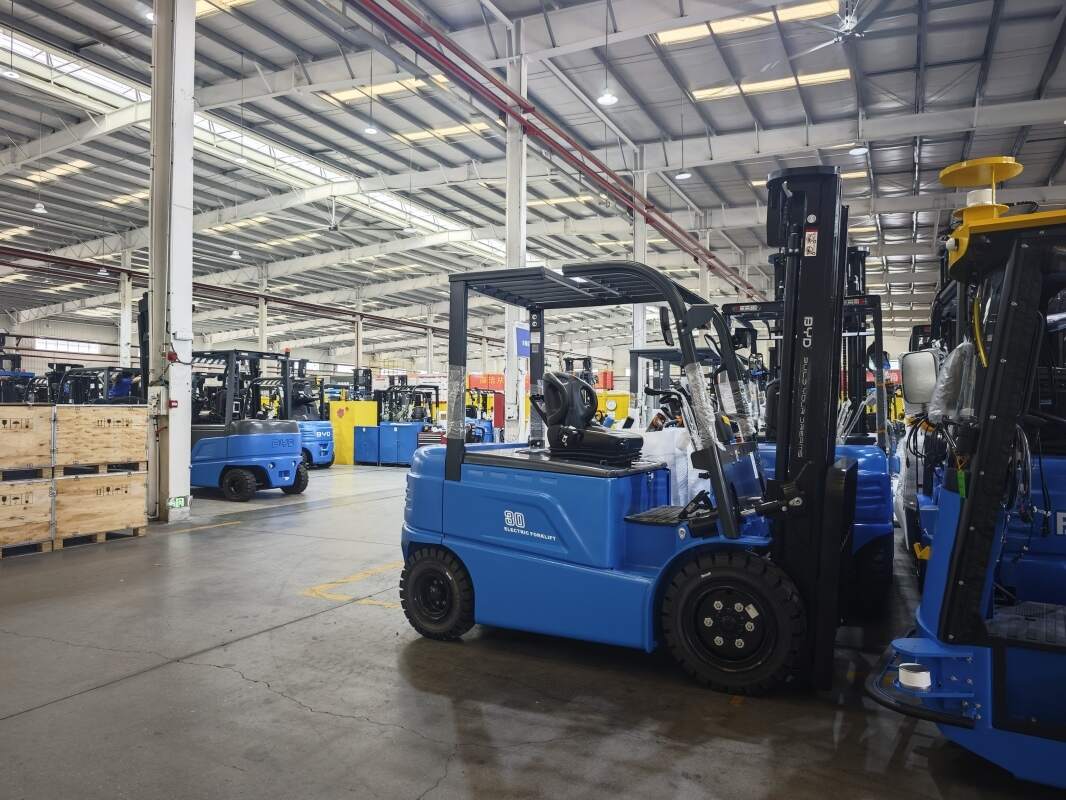
As a professional new energy material handling equipment service provider, Sharp Tree New Energy focuses on BYD electric forklifts. All the electric forklifts we provide have optimized weight distribution design for better basic stability, and we also provide systematic safety training for all users to help operators fully understand the application rules of the stability triangle in daily scenarios. If you have any demand for electric forklift consultation, purchase or safety training, you can send emails to [email protected] for further communication.
In actual operation, following basic rules based on the stability triangle can effectively avoid most stability related accidents. Operators should try to keep the load at a low height when traveling, slow down fully before turning, never overload the vehicle, adjust the fork position to make sure the load is centered, and avoid operating on slopes that exceed the specified safety angle. Regular inspection of tire wear status also helps to ensure the supporting fulcrums work properly, which maintains the effectiveness of the stability triangle to the maximum extent.